
SpaceX has officially entered the final countdown for its historical public market debut. According to the company's S-1 prospectus publicly filed with the Securities and Exchange Commission (SEC), the space exploration giant aims to list on the Nasdaq under the ticker symbol SPCX on June 12, 2026. Setting an initial offering price of $135 per share, the company targets a record-breaking $75 billion capital raise, placing its valuation near $1.77 trillion.
For more than a decade, Space Exploration Technologies Corp. (SpaceX) has reigned as the crown jewel of the global private technology market. Under the leadership of Elon Musk, the company has successfully transformed from a struggling rocket startup into a dominant space launch provider, a global satellite internet operator, and a primary defense partner for the United States. Despite its scale, the company remained private, limiting investment opportunities to institutional funds and employees. This private structure is about to change, reshaping Wall Street in the process.
On May 20, 2026, SpaceX filed its S-1 registration statement with the SEC, formally initiating its initial public offering (IPO). The prospectus outlines a massive financial plan: the company intends to issue new shares to raise up to $75 billion. With an expected trading date of June 12, 2026, the IPO is set to value the company at approximately $1.75 trillion to $1.77 trillion, making it one of the largest public listings in global financial history. This offering will provide retail investors with their first direct opportunity to invest in the commercialization of low-Earth orbit and beyond.
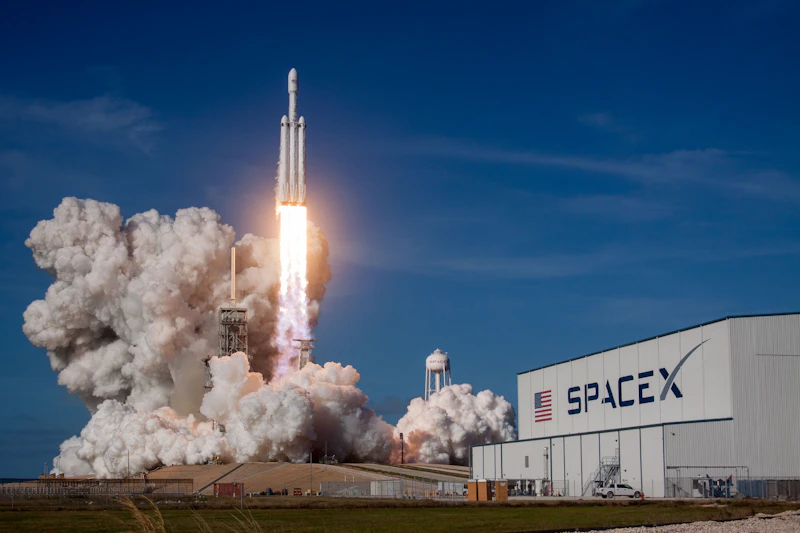 SpaceX is transitioning from a private venture to a public giant, funding its next phase of deep-space and AI integration.
- Target Listing Date: Expected to list on the Nasdaq under the ticker SPCX on June 12, 2026, with pricing finalized on June 11.
- Offering Price: Initial public offering price is set at $135 per share, aiming to raise $75 billion.
- Trillion-Dollar Valuation: The listing targets an initial market capitalization of $1.75 trillion to $1.77 trillion.
- Massive Retail Allocation: Up to 30% of the offering is reserved for retail investors, distributed through platforms like Fidelity, Schwab, and Robinhood.
- Strong Financial Engine: Disclosed 2025 revenue reached $18.67 billion, driven primarily by Starlink's $11.39 billion sales.
- AI Integration Impact: The integration of xAI in early 2026 adds substantial growth prospects but brings a GAAP net loss of $4.94 billion for 2025.
The Road to Nasdaq: Structure and Mechanics of the SpaceX IPO
The transition of a company valued at over a trillion dollars from the private secondary market to a public exchange is a complex financial process. Historically, SpaceX managed its valuation through periodic private tender offers, allowing employees to cash out shares at set prices. The final pre-IPO private secondary market price, tracked on platforms like Forge Global, hovered around a derived value of $129.01 per share. The set IPO price of $135 per share represents a modest 4.6% premium over these private transactions, indicating that underwriters are looking for a stable debut rather than an aggressive valuation spike.
According to the S-1 filing, Morgan Stanley, Goldman Sachs, and JPMorgan Chase are leading the underwriting syndicate. The planned capital raise of $75 billion is intended to fund three primary areas: the rapid deployment of Starlink v3 satellites, the construction of Starship launch infrastructure, and the expansion of the company's recently integrated AI segment. By issuing new equity, SpaceX is bringing a massive amount of liquidity to the market, testing the depth of institutional demand during a period of shifting global macroeconomic conditions.
The public listing is structured as a dual-class share system, which has become common in founder-led technology companies. Class A common stock will be sold to the public, carrying one vote per share. Class B stock, which is not being publicly offered, carries 10 votes per share and is held by Elon Musk and early institutional backers. The prospectus notes that this structure will allow Musk to retain approximately 78% of the total voting control of the company, despite owning a minority of the economic shares. This governance structure ensures that long-term strategic plans—including the colonization of Mars—remain protected from short-term investor pressures.
The Retail Revolution: Breaking Wall Street's IPO Allocations
In a major departure from traditional IPO structures, SpaceX is prioritizing individual investors. Typically, major investment banks reserve 90% or more of high-demand IPO shares for institutional clients like mutual funds, hedge funds, and pension boards. Retail investors are usually left to buy shares on the open market once trading begins, often at a premium. For this offering, however, SpaceX has reserved up to 30% of its IPO shares for retail investors, creating a massive pool of shares for the general public.
To distribute these shares, SpaceX has partnered with major consumer brokerage platforms. Fidelity, Charles Schwab, Robinhood, SoFi, and E*Trade have all launched dedicated portals for their customers to submit indications of interest (IOIs). To make the IPO as accessible as possible, Fidelity lowered its minimum account balance requirement to $2,000 specifically for this offering. Charles Schwab has maintained a higher account threshold of $100,000, while Robinhood and SoFi require no minimum balance, allowing anyone with an active account to apply for shares at the $135 offering price.
However, this access comes with strict rules to prevent short-term speculation. Participating brokerages are enforcing strict anti-flipping policies to prevent retail investors from immediately selling their shares on the first day of trading. Fidelity, for example, defines flipping as selling IPO shares within 30 days of the listing. Investors who violate this rule are barred from participating in any future IPOs through the platform for a period of 12 to 24 months, helping stabilize the stock's price during its initial trading weeks.
- Fidelity: Lowered minimum portfolio balance to $2,000 for this IPO; enforces a strict 30-day anti-flipping restriction.
- Charles Schwab: Requires a minimum account balance of $100,000 to submit an indication of interest.
- Robinhood & SoFi: No minimum account balance required; allocations are determined by proprietary algorithms.
- Flipping Penalty: Selling allocated shares within 30 days results in a temporary ban from future IPO participation.
The Financial Engine: Starlink and Launch Segment Dynamics
The S-1 prospectus provides the first comprehensive look at SpaceX's financial performance. For the fiscal year ending December 31, 2025, the company reported consolidated revenue of $18.67 billion, representing a 33% increase from 2024. While the company reported a GAAP net loss of $4.94 billion due to heavy investments and AI integration, its Adjusted EBITDA was a positive $6.58 billion. This shows that the company's core operations are highly profitable before accounting for developmental research and capital expenditures.
The financial results show that SpaceX relies on its two main divisions: Starlink and Launch Services. Starlink has become the primary revenue engine for the company, generating $11.39 billion in 2025, which accounts for approximately 61% of total sales. Starlink is also the only division operating at a net profit, reporting an operating income of $4.42 billion. The traditional Launch Services division generated $4.09 billion in revenue but reported an operating loss of $657 million. This loss is primarily due to the high research and development costs associated with the Starship vehicle, which is still in its testing phase.
- Connectivity (Starlink): Generated $11.39 billion in 2025 revenue, operating at a net profit of $4.42 billion.
- Space Launch: Recorded $4.09 billion in 2025 revenue, incurring an operating loss of $657 million due to Starship R&D.
- AI Integration: Added via xAI in early 2026, creating a GAAP operating loss of $6.36 billion in 2025.
| Business Segment | 2025 Revenue ($B) | Operating Income ($M) | CapEx Intensity | Growth Trajectory |
|---|---|---|---|---|
| Starlink (Connectivity) | $11.39B ▲ Leading | +$4,420M ▲ Leading | Moderate ≈ Parity | Hyper-Growth ▲ Leading |
| Launch Services (Space) | $4.09B ≈ Parity | -$657M ▼ Behind | High ▼ Behind | Steady Growth ≈ Parity |
| AI (Integrated xAI) | N/A (Pre-Rev) ▼ Behind | -$6,360M ▼ Behind | Extreme ▼ Behind | Unproven ▼ Behind |
The financial data confirms that Starlink's profitable subscription model is funding the development of the Starship program. As Starship matures and begins commercial operations, it is expected to significantly reduce launch costs, which will in turn help expand the Starlink constellation. This operational link between divisions creates a self-sustaining cycle, reducing SpaceX's reliance on external capital and positioning it for long-term growth as a public company.
The Launch Cadence: Starlink Expansion and Constellation Growth
The scaling of SpaceX's business model relies on its unmatched launch cadence. In 2025, the company completed a record-breaking 165 orbital launches, up from 134 in 2024 and 96 in 2023. This means the company averaged a launch every 2.2 days, establishing a launch capacity that no other company or government space agency can match. The majority of these launches were dedicated to internal Starlink deployments, with 122 missions used to expand the satellite constellation and 43 missions dedicated to paying commercial and government clients.
This frequent launch schedule has allowed Starlink to rapidly expand its global service area. The satellite internet service added more than 4.6 million active subscribers in 2025, ending the year with approximately 9.0 million users worldwide. This momentum continued into 2026, with the subscriber base crossing 10.3 million by March 31, 2026. This expanding user base provides the recurring revenue needed to fund the company's next-generation programs, demonstrating the commercial viability of satellite internet.
Additionally, the launch division is preparing for the commercial rollout of Starship, the largest rocket ever built. Starship is designed to be fully reusable, which is expected to lower the cost of launching heavy payloads to low-Earth orbit to under $100 per kilogram. This dramatic cost reduction will allow the company to quickly deploy its Starlink v3 satellites, which are too heavy for the current Falcon 9 rocket. The upcoming IPO funds will help complete the launch sites in Boca Chica, Texas, and Cape Canaveral, Florida, which are crucial for starting regular Starship operations.
Strategic Integration and the AI Frontier
The most surprising disclosure in the S-1 prospectus is the financial integration of xAI, Elon Musk's artificial intelligence venture. In February 2026, SpaceX completed a corporate restructuring that brought xAI under its corporate umbrella. While this merger gives SpaceX direct access to advanced AI for autonomous navigation, satellite routing, and robotics, it also adds significant near-term financial challenges. In 2025, the AI segment reported an operating loss of $6.36 billion, primarily due to the massive capital expenditures required to build and power specialized compute clusters.
The prospectus outlines plans to build a new supercomputing cluster powered by 100,000 liquid-cooled Nvidia H100 GPUs, with plans to upgrade to the newer Blackwell architecture by late 2026. This infrastructure is essential for training the next generation of Grok, xAI's large language model, which will be integrated into Starlink's satellite routing networks. While this AI integration increases near-term losses, SpaceX management argues that it is necessary for building an autonomous, global communications network that can dynamically route data around atmospheric interference and network congestion.
Corporate Governance: The integration of xAI into SpaceX has drawn criticism from some institutional investors, who argue that the merger was designed to fund Musk's AI venture using SpaceX's profitable Starlink cash flow. The S-1 prospectus notes that the board approved the transaction based on the long-term strategic value of AI-driven satellite routing and rocket telemetry analysis.
Furthermore, the S-1 filing details the developmental roadmap for the AI division. Beyond satellite routing, the division is designing custom silicon chips for edge-computing applications on the Starship vehicle and future Mars landers. These specialized AI chips are intended to process telemetry data in real-time, allowing for autonomous navigation during landing sequences in environments where communication lag makes remote control impossible. This long-term research strategy highlights that SpaceX is positioning itself not just as a transport company, but as a deeply integrated technology platform.
Future Outlook: Post-Listing Trajectory and Key Milestones
“We are not just listing a rocket company; we are listing the foundational infrastructure for the next century of human activity. The capital raised in this offering will directly fund the development of Starship and the integration of advanced AI, establishing a platform that will connect the entire planet and enable deep-space exploration.”
— SpaceX Executive Board Statement, S-1 Registration Prospectus, May 20, 2026
As SpaceX transitions to a public company, its success will depend on meeting key milestones over its first year of trading. Investors will be closely watching the company's performance across several critical milestones:
- Finalize the Nasdaq Listing: Complete the pricing of shares on June 11, 2026, and start public trading on the Nasdaq exchange on June 12 under the ticker SPCX.
- Achieve Starship Commercial Readiness: Complete the first fully commercial Starship flight, deploying next-generation Starlink v3 satellites to low-Earth orbit.
- Expand Starlink Coverage: Cross the 12 million active subscriber mark by late 2026, driven by new cellular connectivity services (Direct to Cell) launched in partnership with major mobile operators.
- Deploy the xAI Compute Cluster: Bring the expanded supercomputing cluster online, integrating real-time AI routing into the active Starlink constellation.
- Establish Regulatory Compliance: Transition corporate reporting to meet public SEC standards, including quarterly financial reporting (10-Q) and annual audits (10-K).
Sources and References
- Securities and Exchange Commission (SEC) - SpaceX Form S-1 Registration Statement: sec.gov
- Bloomberg Finance - SpaceX IPO Pricing & Valuation Analysis: bloomberg.com
- Fidelity Investments - IPO Participation Guide and Retail Allocations: fidelity.com
- Forge Global - Private Market Secondary Pricing & Derived Valuations: forgeglobal.com
Post a Comment