
Following the highly anticipated Nasdaq listing of SpaceX under ticker SPCX, a historic 75 billion dollar capital raise has sparked a significant rotation in the aerospace sector. While the industry leader clinched a valuation exceeding 2 trillion dollars on its first day, pure-play space stocks slumped as institutional capital reallocated to the blockbuster debut.
On June 12, 2026, the global capital markets witnessed a watershed moment as SpaceX completed its initial public offering (IPO), debuting on the Nasdaq exchange under the ticker symbol SPCX. The blockbuster offering priced at $135 per share, successfully raising $75 billion in fresh capital, representing the largest IPO in stock market history. Trading opened at $150 per share, immediately drawing intense demand from institutional and retail investors alike.
By the closing bell, the stock climbed to $160.95 per share, representing a first-day gain of 19.22 percent from the offer price. This rapid appreciation pushed the company's market capitalization from its initial $1.77 trillion valuation to a closing high of $2.01 trillion, solidifying its position among the world's most valuable enterprises.
The market debut has had immediate macroeconomic and wealth implications. Financial reports indicate that the listing has officially made CEO Elon Musk the world's first trillionaire, reflecting his substantial equity stake in the company. Beyond personal wealth, the sheer volume of trading in SPCX on its first day established a new record for debut liquidity, with millions of shares changing hands within hours of the opening bell. The scale of the offering represents a structural shift for Nasdaq, as index providers prepare to fast-track the stock into major benchmarks. Financial analysts have observed that the successful IPO serves as a long-awaited proof of concept for the commercial viability of the space economy on a global scale.
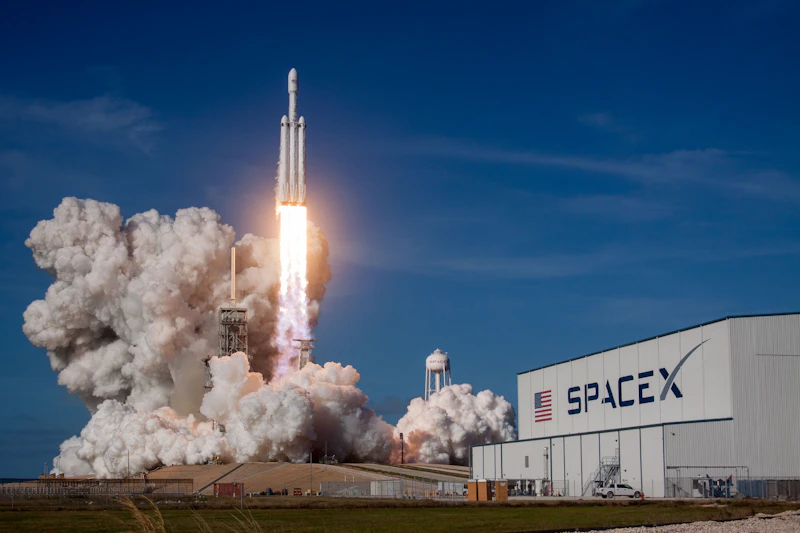 SpaceX's Nasdaq debut under ticker SPCX represents a critical milestone for public space economy investments, raising 75 billion dollars.
- Historic Scale: SpaceX raised $75 billion at a fixed price of $135 per share, making it the largest IPO in financial history.
- Market Valuation: The stock closed its first trading day at $160.95, pushing its market capitalization to $2.01 trillion.
- Sector Rotation: Pure-play space stocks slumped on June 12, 2026, due to profit-taking and institutional capital recycling.
- Financial Disclosures: SpaceX reported 2025 revenues of $18.7 billion, with Starlink contributing $11.4 billion of the total.
- AI Integration: A Q1 2026 net loss of $4.28 billion highlights the massive capital burn associated with the recent xAI merger.
The Gravity Well of Nasdaq: SpaceX's Historic $75 Billion Listing
The successful listing of SPCX is a monumental event for global capital markets. By raising $75 billion, the company has bypassed traditional financing routes, establishing a public valuation that challenges the dominance of traditional mega-cap technology firms. The first day's closing price of $160.95 represents a clear signal that institutional investors are eager to hold liquid, large-cap space equities. This demand is driven by the unique competitive advantages that the firm possesses, including its reusable launch architecture and its dominant position in satellite communications. The listing has altered the structure of the Nasdaq index, as index managers prepare to integrate the company into flagship benchmarks, attracting passive index inflows.
The debut was characterized by three unique operational milestones that highlight its scale:
- Unprecedented Scale: The $75 billion capital raise represents the largest IPO in global financial history, far exceeding Saudi Aramco's $25.6 billion record.
- Valuation Milestones: Climbing to $2.01 trillion on the first day solidifies SpaceX's position as a mega-cap tech leader, putting it in the same class as Microsoft and Nvidia.
- Strategic Integration: Incorporating the xAI merger establishes a new hybrid model of aerospace and artificial intelligence, attracting specialized tech allocators.
To understand the scale of this listing, one must compare it to historical market debuts. The previous record for capital raised was held by Saudi Aramco, which raised $25.6 billion in 2019, followed by Alibaba's $21.8 billion offering in 2014. SpaceX's $75 billion raise nearly triples these previous benchmarks, illustrating the immense liquidity that global investors are willing to deploy for dominant technology platforms.
B Capital Chairman Howard Morgan, however, raised concerns about the pricing process, stating that the IPO felt overpriced. Morgan noted that the price was established without standard market consultation, predicting that a traditional syndication process might have resulted in a lower initial valuation. Despite these criticisms, the trading action on the first day demonstrated that investor appetite for the aerospace pioneer remains robust.
Capital Rotation and Profit-Taking: The Space Stock Shakeout
While SpaceX celebrated a historic debut, the broader space sector experienced a severe sell-off. Pure-play space equities, which had enjoyed a blistering rally in the months leading up to the IPO, slumped as investors moved to capture profits and free up capital. Virgin Galactic (SPCE) led the declines, sinking by 28.00 percent on the day of the IPO to close at its lowest level in months. This sharp decline contrasted with its year-to-date performance, which had seen SPCE gain approximately 75 percent prior to the listing. Similarly, AST SpaceMobile (ASTS) fell by 15.50 percent, despite its strong YTD gain of 45 percent, while Intuitive Machines (LUNR) plunged 13.10 percent from its pre-IPO levels.
The rotation of capital was executed through three distinct channels:
- Liquidity Harvesting: Investors trimmed positions in pure-play space stocks to secure cash for the SPCX debut, locking in gains from the sector's blistering YTD rally.
- Profit-Taking Rotation: Traders locked in gains from the sector's blistering YTD rally (up to 75% for SPCE) to rebalance their aerospace portfolios.
- Benchmark Rebalancing: Passive and active funds adjusted their portfolio weightings to accommodate the new index heavyweight, which created additional selling pressure on smaller names.
Rocket Lab (RKLB), one of the sector's most prominent launch and space systems providers, fell 10.90 percent on June 12, 2026. This pullback occurred despite Rocket Lab's strong operational momentum, which had pushed the stock up 65 percent YTD, supported by record revenue and defense contract backlog. Analysts noted that the widespread declines were not driven by fundamental business failures, but by capital recycling. Institutional investors, holding large positions in smaller space names, trimmed these holdings to reallocate capital into the newly public SPCX. The Procure Space ETF, Ark Space & Defense Innovation ETF, and Roundhill Space and Technology ETF also experienced declines between 1 percent and 6 percent, reflecting the sector-wide rebalancing.
“This is space's Netscape moment. While the space industry existed prior to June 12, this blockbuster IPO has changed the perception overnight and opened the floodgates for internet-scale capital investment.”
— Chad Anderson, CEO of Space Capital, Industry Briefing, June 2026
The rotation highlights the challenges that smaller aerospace firms face when a dominant player enters the public market. The listing changed the perception overnight and opened the floodgates for aerospace investment. However, this influx of capital has concentrated in the sector leader, leaving smaller pure-plays to compete for remaining liquidity. Planet Labs (PL) also declined by 9.50 percent on the day, showing that even Earth observation and data-centric space companies were not immune to the capital rotation. As investors digest the new market structure, the performance of these smaller firms will depend on their ability to deliver consistent revenue growth outside of SpaceX's shadow.
Inside the Financial Engine: SpaceX's 2025 Revenue and the AI Capital Burn
SpaceX's IPO prospectus provided the public with its first comprehensive look at the company's financial structure. In 2025, the firm reported total revenue of $18.7 billion, representing a 33 percent increase over the previous year. The company achieved an adjusted EBITDA of $6.6 billion, driven by the strong performance of its Starlink satellite broadband division. Starlink generated $11.4 billion in revenue, representing approximately 61 percent of total company sales, and served as the primary driver of operating cash flow. Sourcing models for Starlink indicate that the division has reached over 10 million active users globally by early 2026, establishing it as a highly profitable utility provider.
Context: The integration of xAI into SpaceX's corporate structure represents a unique hybrid business model. Starlink's recurring, high-margin utility revenues are being utilized to directly subsidize deep-tech capital burn, minimizing the company's reliance on external debt markets but exposing public equity holders to artificial intelligence capital risks.
However, the company's consolidated financials also showed significant net losses. For the full year 2025, SpaceX reported a GAAP net loss of $4.9 billion. This loss was driven by substantial capital expenditure on the development of the Starship launch system and the company's aggressive expansion into artificial intelligence. In February 2026, SpaceX completed a merger with xAI, the AI venture founded by Elon Musk. This transaction has resulted in a massive capital burn, with Q1 2026 net losses reaching $4.28 billion. The company is investing billions of dollars in building large-scale GPU supercomputing clusters, which are integrated with Starlink's ground infrastructure to provide low-latency AI inference services.
The Starlink connectivity division has been structured around three key performance drivers:
- Subscriber Growth: Surpassing 10 million active users globally to drive consistent, high-margin recurring revenues.
- Enterprise Contracts: Expanding maritime, aviation, and government connectivity contracts for high-margin, long-term sales.
- Infrastructure Synergy: Utilizing Starlink ground stations as low-latency inference nodes for xAI's neural models, creating a distributed computing network.
The integration of aerospace and artificial intelligence represents a unique corporate structure. The company is using the high-margin, recurring revenue generated by Starlink to subsidize its deep-tech capital expenditures. While this model allows SpaceX to fund next-generation technologies without relying entirely on capital markets, it also exposes public shareholders to significant risk. Sourcing models project that the company's total revenue for 2026 will reach between $22 billion and $30 billion, depending on the launch rate of Starship and the growth of Starlink's enterprise contracts. Sourcing models also indicate that if the capital burn associated with the AI division continues to accelerate, consolidated profitability may remain out of reach for several quarters.
Pricing Without Consultation: The Institutional Backlash Against Standard Valuation
The pricing structure of the SpaceX IPO has generated considerable debate among Wall Street professionals. Unlike traditional IPOs, where underwriters conduct a roadshow to gauge investor demand and set a price range, SpaceX set a fixed price of $135 per share. Howard Morgan, Chairman of B Capital, criticized this approach as fully priced, or in his opinion overpriced, arguing that setting the price without standard market consultation bypassed the price discovery mechanism. Morgan noted that a traditional syndication process might have resulted in a lower initial valuation, suggesting that the company used its dominant position to dictate terms to institutional allocators.
“The SpaceX IPO was set without standard market consultation. It felt fully priced, or in my opinion overpriced, bypassing standard syndication. It represents a true test of whether the animal spirits of public markets can absorb a fixed-price valuation of this magnitude.”
— Howard Morgan, Chairman of B Capital, Institutional Investor Forum, June 2026
This fixed-pricing mechanism represents a departure from standard capital market practices. Typically, investment banks build an order book to determine the clearing price that balances supply and demand. By bypassing this process, SpaceX was able to capture a larger share of the listing premium for its existing shareholders, but it left some institutional investors feeling sidelined. Uday Kotak, founder of Kotak Mahindra Bank, questioned whether the massive valuation represented a mega bubble or the realization of a fairy tale future. Kotak described the offering as a true test for capitalism, noting that the company's valuation does not fit traditional multiples and relies on long-term growth forecasts.
In contrast, bullish investors argue that the company's dominant market share and unique capabilities justify the premium pricing. Shaun Maguire, a partner at Sequoia Capital, pointed to the huge upside driven by expected revenue growth from Starlink and the deployment of Starship. Maguire noted that SpaceX's vertical integration gives it a structural cost advantage that competitors cannot match. Sourcing models support this view, showing that SpaceX's launch costs per kilogram are significantly lower than those of United Launch Alliance or Arianespace. This cost advantage is expected to sustain the company's market dominance, even as new competitors enter the launch market in the late 2020s.
The Next Launch Window: Broad Market Implications and the Nasdaq-100 Rotation
Looking ahead, the space sector faces several key milestones that will shape investor sentiment. On June 22, 2026, Rocket Lab (RKLB) is scheduled to join the Nasdaq-100 index, a move that will require passive index funds to purchase its shares. This inclusion is expected to provide a significant liquidity boost, helping the stock recover from its post-IPO slump. Rocket Lab's management has emphasized that its long-term value is driven by its diversified business model, which includes a growing space systems division that manufactures satellite components for government and commercial customers.
To compare the market positions and performance metrics of the leading space companies following this historic debut, the table below outlines key valuation and return figures:
| Company (Ticker) | Valuation (June 2026) | IPO Day Return (June 12) | YTD Return (Pre-IPO) | Primary Sub-Category | Competitive Status Badge |
|---|---|---|---|---|---|
| SpaceX (SPCX) | $1.77T - $2.01T | +19.22% | N/A (New Listing) | Satellite Broadband & Heavy Launch | ▲ Leading |
| Rocket Lab (RKLB) | $9.8B - $10.5B | -10.90% | +65.0% | Medium Launch & Space Systems | ≈ Parity |
| AST SpaceMobile (ASTS) | $4.2B - $4.8B | -15.50% | +45.0% | Direct-to-Cell Connectivity | ≈ Parity |
| Intuitive Machines (LUNR) | $1.1B - $1.3B | -13.10% | +38.0% | Lunar Infrastructure & Robotics | ▼ Behind |
| Virgin Galactic (SPCE) | $0.8B - $0.9B | -28.00% | +75.0% | Suborbital Space Tourism | ▼ Behind |
| Planet Labs (PL) | $0.75B - $0.85B | -9.50% | +12.0% | Earth Observation & Geospatial | ▼ Behind |
The rotation of capital out of smaller space stocks into SPCX is expected to consolidate the sector. Analysts predict that smaller, pre-revenue space companies may struggle to raise capital in the public markets, leading to a wave of mergers and acquisitions. Companies with strong balance sheets and established revenue streams, such as Rocket Lab and AST SpaceMobile, are positioned to survive the shakeout and potentially acquire distressed assets. The broader U.S. market, meanwhile, has absorbed the SpaceX IPO with relative ease, as major indices like the S&P 500 and Nasdaq ended the session higher, supported by easing oil prices and the positive sentiment surrounding the historic debut.
The long-term outlook for the space economy depends on the execution of major infrastructure projects. Sourcing models show that the deployment of Starship and the expansion of AST SpaceMobile's direct-to-cell satellite constellation will require billions of dollars in continued capital expenditure. Sourcing models also suggest that if these projects deliver on their technological promises, they could unlock new markets in satellite communications, orbital manufacturing, and space tourism. For investors, the post-IPO slump in pure-play space stocks may represent a buying opportunity, provided they focus on companies with clear paths to profitability and strong competitive positions in the evolving aerospace landscape.
Conclusion: The Future of Global Aerospace Capital Sourcing
The Nasdaq listing of SpaceX has reshaped the investment landscape of the global space economy. By attracting 75 billion dollars in a single debut, the company has demonstrated that the public markets possess the depth to absorb mega-cap aerospace valuations. While the immediate capital rotation has caused a sharp sell-off in smaller pure-play equities like Virgin Galactic and AST SpaceMobile, this shakeout is seen by many analysts as a healthy correction that separates fundamentally sound enterprises from speculative ventures. As SpaceX deploys its capital into Starship and xAI supercomputing infrastructure, the sector's long-term returns will be determined by its ability to transition from speculative valuation multiples to sustainable operating cash flows.
Sources and References
- Nasdaq - Market reports and official ticker indices: nasdaq.com
- Securities and Exchange Commission (SEC) - S-1 Registration Filings and Prospectuses: sec.gov
- Space Capital - Industry research briefs and venture funding database: spacecapital.com
- Reuters - Aerospace and market reporting: reuters.com
Post a Comment