
South Korea's KOSPI plunged 10% in a single session. The Nasdaq fell for a second straight day. And somewhere beneath the panic was one number that started it all: $725 billion.
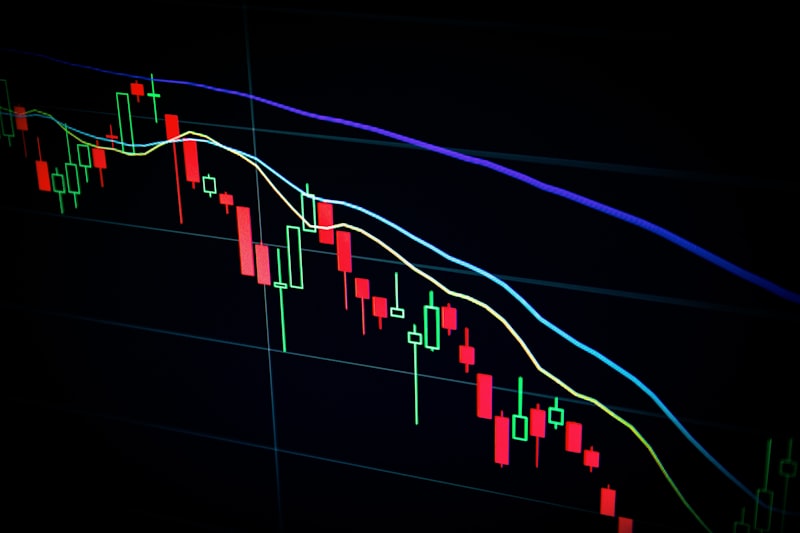 Global markets recoiled on June 23–24, 2026, as AI spending fears triggered the broadest tech sell-off since early 2025. (Unsplash)
Circuit breakers do not trip lightly. When South Korea's stock exchange halted trading on June 23, 2026, after the KOSPI collapsed nearly 10% in a single session, it marked one of the most dramatic single-day market events in recent memory for a major economy. Samsung Electronics shed more than 12% of its market value. SK Hynix fell by a similar margin. Across the Pacific, the Nasdaq Composite dropped 2.21%, extending a two-day losing streak that wiped hundreds of billions of dollars from the most closely watched technology stocks on earth.
The proximate cause was a question — one that Wall Street has been deferring for the better part of two years: when exactly does $725 billion in AI infrastructure spending start paying off?
How a Broadcom Earnings Miss in June Became a Global Rout by Late June
To understand the June 23 sell-off, the story actually begins on June 5. Broadcom reported Q3 AI chip sales guidance of $16 billion — a significant number by any ordinary measure, but $1.2 billion short of analyst estimates that had priced the stock for perfection. Markets responded violently. The Philadelphia Semiconductor Index plummeted more than 6% on that single session, erasing approximately $1.3 trillion in market capitalization from the global chip sector. AMD fell 10.86%. Intel dropped 11.28%. Nvidia shed 6% and temporarily lost its $5 trillion market cap.
That June 5 shock was the first crack. The June 23 session was the second wave — and by then, investor anxiety had compounded. Traders were pricing in a 50-basis-point Federal Reserve interest rate hike by December 2026, raising borrowing costs for the capital-intensive companies at the center of the AI build-out. And Micron Technology's earnings report loomed, with memory chip prices serving as a direct proxy for AI infrastructure demand. Memory chipmakers bore the brunt of the June 23 selling: Micron fell 13.2%, Sandisk dropped over 13%, and Samsung and SK Hynix both lost more than 12% on the Seoul exchange before circuit breakers intervened.
A circuit breaker is an automatic trading halt triggered when an index falls beyond a pre-set threshold in a single session, designed to prevent panic-driven free-fall. South Korea's KOSPI triggered its circuit breaker mechanism after the index declined more than 8% intraday on June 23 — a level not seen since the COVID-19 crash of March 2020. The extraordinary severity reflected Korea's concentrated exposure: Samsung, SK Hynix, and related semiconductor suppliers collectively represent a major portion of KOSPI's total market cap, meaning AI-sector fear lands disproportionately on Korean equities.
The $725 Billion Question: AI CapEx and the Patience of Markets
The sell-off is inseparable from the number sitting at its center. Microsoft, Alphabet, Meta, and Amazon are collectively projected to spend up to $725 billion on capital expenditures in 2026 — funding data centers, GPU clusters, power infrastructure, and custom AI silicon. This is an arms race by any measure, and it is being conducted entirely on credit: the assumption that AI will generate returns that justify the spend before the balance sheets buckle.
The problem is that investors are running out of patience. After two years of hearing that AI infrastructure investment is a "once-in-a-generation opportunity," they are beginning to ask for proof. The market's demand is simple: show us the free cash flow. Instead, what they are seeing is margin compression, higher-than-expected capital expenditure guidance revisions, and a concentration of revenue contribution from a very narrow slice of commercial AI applications.
The capital flows break into distinct categories. Chipmakers — led by Nvidia — are the clearest beneficiary of the AI build-out, with their revenue directly tied to GPU sales for training and inference infrastructure. TSMC, which manufactures the physical silicon for Nvidia, Apple, and AMD, is a second-order beneficiary. But cloud providers (Microsoft Azure, Google Cloud, Amazon Web Services) are in a more complex position: they are simultaneously the largest buyers of AI infrastructure and the companies that must persuade enterprise customers to spend on AI services in sufficient volume to cover the depreciation on those assets.
- Nvidia: Revenue directly tied to GPU orders; highest near-term visibility, but most vulnerable to any guidance miss.
- Cloud hyperscalers (Microsoft, Google, Amazon): Spending heavily now; revenue materializes as enterprise AI adoption scales — timeline uncertain.
- Meta: Lacks a cloud business; AI investment must justify itself through advertising engagement gains — the hardest ROI story to tell.
- Memory chipmakers (Micron, Samsung, SK Hynix): Benefiting from HBM demand; most exposed to any signal that AI training runs are being slowed or rescheduled.
Compounding the capex anxiety is the Federal Reserve. Markets in mid-June 2026 were pricing in a 50-basis-point interest rate hike by December — a meaningful tightening in a market that had spent 18 months pricing in cuts. For high-multiple growth stocks, the mechanics of rising rates are unforgiving: the present value of future cash flows is discounted at a higher rate, compressing the valuations that justified the AI rally's most extreme price levels.
Consider the arithmetic. A company trading at 40x forward earnings with a 4% discount rate is priced very differently from the same company at a 5% discount rate. The delta in fair value is not marginal — it is structural, and it re-prices the entire sector simultaneously. This is why Nvidia's 4.1% decline on June 23 was actually modest compared to Micron's 13.2% drop: Nvidia's near-term earnings visibility is higher, making it less sensitive to discount rate changes than companies whose profits are more speculative or cyclically exposed to memory commodity pricing.
Goldman Sachs' Head of Global Equity Research, Jim Covello, has been blunt about the risk. He has argued that while chipmakers are seeing real profits from the AI cycle, cloud providers and enterprise customers are still waiting for meaningful payoffs — and that the business case for the aggregate AI spending level remains, in his words, unproven. Goldman's broader strategist team has warned that investor expectations may be "racing ahead of reality" while noting that the macro imbalances of 2026 are not yet as severe as those that defined the dot-com crash of 2000-2002.
"The risk of underbuilding computing resources for AI is often greater than the risk of a bubble. But the market is right to ask for evidence of the economic translation."
Samsung's $59 Billion Buyback and the Speed of a Technical Rebound
Less than 24 hours after circuit breakers halted Korean trading, Samsung Electronics shares surged approximately 9% on June 24. The catalyst was a local media report indicating that the company was planning a share buyback program potentially worth up to 90 trillion won — approximately $59 billion — over the next three years, funded partly to support employee stock compensation following recent labor agreements.
The rebound was real but contextually limited. Analysts characterized it as a technical recovery driven by bargain-hunting and position covering rather than a fundamental shift in sentiment. TSMC shares remained under pressure even as Korean stocks recovered, and investor anxiety about the upcoming Micron earnings report continued to overhang the sector.
- South Korea's KOSPI fell 10% on June 23, triggering circuit breakers for the first time since March 2020. Samsung and SK Hynix each lost 12%+ intraday.
- The Nasdaq dropped 2.21% for a second straight day. The Philadelphia Semiconductor Index had already lost ~$1.3 trillion in market cap on June 5 after Broadcom's miss.
- The root cause is a $725B AI capex spend by four hyperscalers (Microsoft, Google, Meta, Amazon) with no clear near-term monetization timeline established.
- Goldman Sachs warns expectations are "racing ahead of reality"; Morgan Stanley frames AI as a strategic necessity, not a bubble.
- Samsung announced a $59B buyback plan; Asian stocks rebounded ~9% on June 24, but analysts called it a technical correction, not a sentiment shift.
Dot-Com Deja Vu, or Structural Correction? What the Analysts Actually Disagree On
The bubble question refuses to resolve cleanly. Every historical comparison has a caveat. The dot-com era of 1999-2000 involved companies with negligible revenues trading at price-to-sales multiples of 50x or more; by contrast, Nvidia posted $61 billion in annual revenue in fiscal 2024 and is projecting continued growth. The companies at the center of today's AI rally have real earnings, real cash flows, and real infrastructure. That is the strongest argument against a bubble designation.
But there are important parallels that the most cautious analysts are not willing to dismiss. In both eras:
- A narrow group of high-multiple stocks drove the bulk of index returns, creating concentration risk that distorted broader market signals.
- Capital expenditure commitments were made on the basis of anticipated demand that had not yet fully materialized.
- The marginal buyer in the final phase of the rally was retail investors entering at peak valuations.
Morgan Stanley's position — that the risk of underbuilding AI infrastructure is greater than the risk of overbuilding — reflects the long-run bull case: that AI's eventual productivity impact will justify the current capital intensity many times over, and that companies which fail to invest now will find themselves structurally disadvantaged in a 2028-2030 landscape. Goldman's caution, by contrast, reflects the near-term reality: every quarter that passes without clear enterprise AI monetization at scale is a quarter that tests the market's willingness to fund the next leg of the spend.
- Micron's earnings report: Memory chip demand — specifically High Bandwidth Memory (HBM) orders from AI data center operators — is the closest real-time proxy for whether the AI training pipeline is accelerating or pausing. A miss here would likely trigger another leg down in semiconductor stocks.
- Federal Reserve language on rates: Markets are currently pricing a 50-basis-point hike by December 2026. Any Fed communication that softens or hardens that expectation will move high-multiple growth stocks immediately and dramatically.
- Q2 earnings from the hyperscalers: If Microsoft Azure, Google Cloud, or Amazon Web Services report AI-driven cloud revenue acceleration that materially outpaces their capex guidance, the narrative shifts from "spending problem" to "flywheel beginning to turn." That is the single data point the market most needs.
The June 23 sell-off is best understood not as a verdict on AI's future, but as a demand for accountability — a market mechanism forcing the companies that have spent the most extravagantly to prove, quarter by quarter, that the infrastructure they are building is connected to the economic output they have been promising. Whether that proof arrives in Q2 earnings, or whether the wait extends further, will determine whether June 2026 is remembered as the beginning of a deeper correction, or simply the most turbulent checkpoint on a longer upward path.
What makes this moment structurally different from 2000 is that the capex commitments cannot easily be walked back. Data centers under construction will not be abandoned. GPU orders already placed will not be cancelled without significant contractual penalties. The hyperscalers are, in a meaningful sense, locked into the next 18 months of spending regardless of how markets react in the short term. That inflexibility is simultaneously the strongest argument for the long-term AI thesis — the infrastructure will exist and will be monetized eventually — and the clearest explanation for why the market's patience is the only real variable left in the equation.
Post a Comment